
A Brief History of
Angel Island

Pre-European Contact
The Miwok people, the first people in the Marin and Bay Area, established camps on Angel Island, in areas that are now known as Ayala Cove, Camp Reynolds, Fort McDowell, and the Immigration Station, several thousands of years ago. They used the island as a seasonal hunting and gathering area and were highly skilled at fishing and hunting deer, seals, sea lions, and sea otters. A variety of fish and shellfish were available throughout the year, while salmon and other highly valued fish were abundant during certain seasons. Annual spawning runs passed through Raccoon Strait, just offshore from Angel Island. In addition, the Miwok people hunted ducks and other seabirds and gathered acorns, buckeyes, and other seed crops, along with selected roots and leaves, to support a diverse and balanced diet.
Stewardship of the island began with the Miwok people, who practiced land management techniques such as using prescribed fire to encourage the growth of native oak trees and other plant life. Today, park staff continue this tradition by carefully supervising prescribed burns to help reduce the risk of catastrophic wildfires within the park.
Spanish & Mexican Era
On August 5th, 1775 the San Carlos, and Lt. Juan Manuel de Ayala, sailed into the San Francisco Bay and dropped anchor in what is now called Ayala Cove. Ayala was charged with developing an accurate map and tidal description of the Bay that future Spanish captains could rely on.
The ship's pilot and cartographer, Don Jose de Canizares, explored the Bay in San Carlos' skiff, mapping each inlet for the first time. Lt. Ayala kept his ship anchored near the island and christened it 'Isla de Los Angeles'.
In the early 1800's the island was largely uninhabited - the indigenous Miwok had either been forcibly moved to Mission San Francisco de Asis (now known as Mission Dolores) or driven out of the area. Sea otter trappers from Russia and a British sloop-of-war (the HMS Raccoon) had used the island periodically prior to Mexico's war of independence.
After Mexico declared independence from Spain in 1821, Antonio Maria Osio, the military commandant of Alta California, requested the island to use as a cattle ranch. Many houses were built in this time to house his ranchers and attendants, however Osio never lived on the island.
After Mexico's defeat in the Bear Flag Revolt, Osio fled the area and the US Navy claimed the island.

Military Use and Becoming a State Park
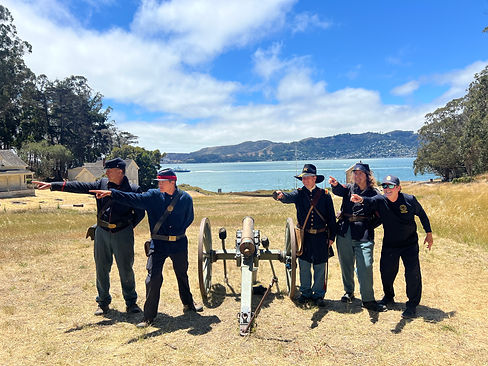
Angel Island has served the US armed services in a number of ways since the US Army established Camp Reynolds on its Western shore. Camp Reynolds was built in 1863 to defend San Francisco from Confederate sympathizers. Following the end of the war, Angel Island was used as a staging area for troops on campaigns against like the Apache, Modoc and Sioux, and others.
By 1905, Fort McDowell (Angel Island was renamed by the Army in 1900) had processed some 87,000 men en route and from the Pacific. In the onset of World War 1 Fort McDowell was heavily used, serving as a temporary detention center for "enemy aliens" (mostly German citizens who had been arrested as they arrived in West Coast ports).
When the US was thrust into WW 2 on December 7th, 1941 Fort McDowell was again used as a military prison for German, Italian and Japanese POWs, as well as a major departure point for the Pacific Theater.
In 1946 the Army declared the property "surplus property" and by 1947 there was a movement under way to preserve the island as a park, led by Caroline Livermore (the namesake of the park's highest point, Mt Livermore). Eventually the group was able to acquire 37 acres of the island around Ayala Cove but in that time the US Army had opened a Nike missile base and further preservation was halted for a time. The missile base closed in 1962 and the entire island was turned over to the State of California, with the requirement that an unmanned Coast Guard station remains active at Pt Blunt.